How to Solve Water Sort Puzzles: A Strategy Guide
In this guide
- The one rule that drives every level
- Why empty bottles are your most valuable move
- Read the bottles from the bottom up
- Finish one color early
- Avoid burying colors you will need soon
- Use the helpers without ruining the puzzle
- When to restart instead of pushing on
- A simple routine for any level
- Where to go next
- Frequently asked questions
Water sort puzzles look like they should be easy. You pour colored liquid between bottles until each bottle holds one color. Then you reach a level where every move seems to make things worse, and the bottles end up as a muddle you cannot untangle.
The difference between guessing and solving is a handful of habits. This guide covers them in the order you will use them: understand the one rule, protect your free space, plan from the bottom, and know when to start over.
The one rule that drives every level
In nearly every water sort puzzle, you can pour from one bottle into another only if the receiving bottle has room and its top layer is the same color as the layer you are pouring, or the bottle is empty. In Water Sort Puzzle, that is the whole rule set: water goes onto the same color, and only if there is space for it.
Everything else in this guide follows from that. Because you can only pour onto a matching color, a layer buried under a different color cannot move until the layers above it are out of the way. Most hard levels are really about one question: in what order do I uncover the buried layers?
Why empty bottles are your most valuable move
Free space is what lets you move at all. An empty bottle accepts any color, so it is a parking spot for whatever is in your way. A bottle with a lot of room left is nearly as good. The tighter the board gets, the fewer moves you have, and a board with no legal moves is a failed level.
That is why the first pour of a level deserves more thought than it usually gets. Filling your only empty bottle with the first color you can move feels productive, but it often removes your only parking spot. Color Water Puzzle says as much in its own guidance: treat free space as precious, and spend it on a color that unlocks several other moves.
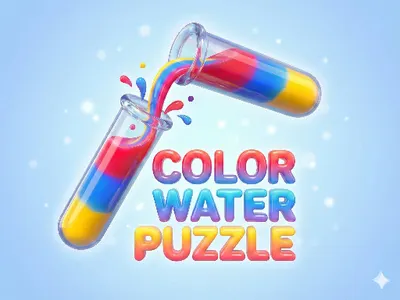 Color Water Puzzle Pour colored water from glass to glass until every glass holds a single color. Play Color Water Puzzle
Read the bottles from the bottom up
Beginners look at the top layers, because those are the ones they can move. Solvers look at the bottom layers, because those decide how the puzzle ends. Every bottle will eventually need a single color, and the color at the very bottom tells you which color that bottle is going to be.
Scan the board and note which colors sit at the bottom of which bottles. If two bottles both have blue at the bottom, one of them will have to be emptied into the other at some point, so plan for that. If a bottle has a different color at the bottom than anywhere else on the board, that bottle is a long way from finished and should be dealt with early, before it gets buried deeper.
Finish one color early
When you can complete a color, do it. A finished bottle is one fewer bottle you have to think about, and it stops that color from turning up in your way later.
There is a caution here. Finishing a color is only a good idea if it does not use up the space you need. If the move that completes a color also fills your last gap and traps three other colors, it is better to wait one move and free something else first. Completion is a reward for good planning, not a goal to chase blindly.
Avoid burying colors you will need soon
You cannot pour onto a mismatched color, but there is a quieter way to bury one: pouring it into a bottle whose layers below it are different. The pour is legal, because the top color matches, but you have just stacked a layer on top of something that does not belong there.
Before you pour, look at what is under the receiving layer. If the layers below are a color you will need to reach soon, you are making your own future harder. Pour onto a stack only when you are happy with what is underneath it, or when it is the only way to open up the move you really want.
A useful test is to ask what the bottle will look like after the pour, and what you would have to do to undo it. If the undo takes three moves, think again.
Use the helpers without ruining the puzzle
Both games give you a way out when a level is too tight. Water Sort Puzzle has a help option, and Color Water Puzzle offers a prop that adds an extra glass. An extra glass is the same thing as an extra empty bottle, which, as we saw, is the single most useful thing you can have.
The best time to use these is after you have honestly tried a level and understand why it is stuck. If you use a helper on the first move, you skip the part where you learn how the level is built. If you save it for when you have tried a plan and seen it fail, you get a fresh idea about what went wrong.
When to restart instead of pushing on
A level can quietly become unsolvable several moves before you notice. If you have made a handful of moves with nothing to show for them, and every bottle is now close to full, the cheapest fix is almost always a restart.
Treat the restart as information. You now know what the board looks like and which colors are buried where, so you can open differently. Try a different first pour, for example by moving a bottom layer you had ignored, and see what changes. A restart that tests a new idea teaches you more than twenty more moves in a dead end.
A simple routine for any level
If you want something you can apply every time, here is a short checklist to run through before your first pour.
- Count your empty bottles and note how much spare room the rest have.
- Look at the bottom layer of every bottle and group the matching colors in your head.
- Pick a color that you can finish without using up your free space.
- Make your first pour, then re-check the board before the second.
- If you are out of ideas, restart and try a different opening.
Where to go next
Once water sorting feels comfortable, the same habits of planning, keeping options open and reading the board help in other logic games. Games such as Unblock It 3D and Apple Worm reward the same kind of patient thinking. Browse the puzzle category for more, or read our roundup of the best free puzzle games for ideas.
Frequently asked questions
Can every water sort level be solved?
Levels in a well-made game are built to be solvable. If you are stuck, it usually means an earlier move used up your free space or buried a color. Restarting and opening differently is often all it takes.
Should I always pour into the bottle with the most water?
No. What matters is what is underneath the layer you pour onto and how much room you leave yourself. A nearly full bottle can lock up your moves, while a quiet pour into a half-empty bottle can open several.
Is it cheating to use the help option?
Not at all. It is part of the game. You will learn more if you try a few plans first, then use the help when you can explain why the level is stuck.