Peg Solitaire: How to Finish With One Peg
In this guide
Peg Solitaire looks simple. A board is full of pegs apart from one empty hole, and you remove pegs by jumping over them. The goal is to finish with a single peg. Then you try it, and discover that you are left with five scattered pegs and no legal jumps.
The game does not reward clever tricks so much as good habits. This guide explains how a jump works and which principles help you finish cleanly. It deliberately does not give a move-by-move solution, because the point of the game is to work one out yourself.
How a jump works
A peg can jump over a neighboring peg if the hole directly beyond that neighbor is empty. The peg lands in the empty hole, and the peg that was jumped over is removed from the board. Each jump removes exactly one peg and leaves two new empty holes behind: the one the jumping peg started in, and the one it jumped over.
That is the entire rule. In Peg Solitaire on IviGames, you select a peg that has a neighbor with an empty hole beyond it, and make the jump. You keep jumping until no moves are left. If one peg remains, you have solved the board.
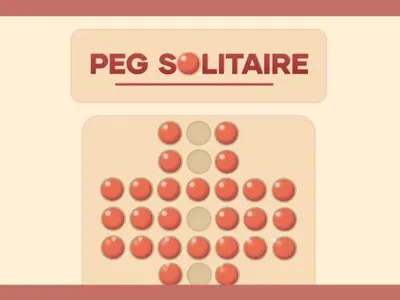 Peg Solitaire The centuries-old board puzzle: jump pegs over each other until only one is left. Play Peg Solitaire
Why the puzzle is harder than it looks
Every jump changes the board, and the changes pile up. The number of pegs goes down by one each time, so the number of jumps you get is limited. If you waste moves, or make jumps that leave pegs out of reach, you run out of options before you reach one peg.
The most common failure is a stranded peg. A peg with no neighbors can never be jumped and can never jump, so it stays on the board for good. If you end the game with two or three scattered pegs, the cause is nearly always a mistake made a long time earlier.
This is also why the puzzle feels fair rather than random. Nothing is hidden and nothing is left to chance, so every failure is a planning failure you can learn from, and the next attempt can be better.
Work from the outside in
Pegs on the edges and in the corners have fewer neighbors, so they are the hardest to jump or to use later. The center of the board is where all the activity is, and pegs there can reach many holes.
A good general approach is to deal with the outer pegs first, using the central pegs and holes as your working area. If you leave the edges until late, you may find that the pegs you need to remove are out of reach of anything else. The aim is to finish with the last pegs in the middle, where they can still move, not isolated in a corner.
Keep your pegs in a group
A peg can only jump or be jumped if it has a neighbor. So a compact group of pegs is a flexible one, and a sprawling, broken-up board is a dead one. Before each jump, picture how the board will look afterward and ask whether the remaining pegs are still close together.
If a jump splits the group into two parts with a wide gap between them, think hard before making it. Often a different jump removes the same peg and keeps the pieces connected.
A simple check is to count the neighbors of each peg you are about to leave behind. A peg with two or three neighbors still has a future. A peg with none has none. Make that count a part of every move and you will strand far fewer pegs.
Look at what a move leaves behind
Beginners look at what a jump removes. Better players look at what it leaves. Each jump creates two new empty holes, and those holes are the only places other pegs can land.
Before you jump, check three things: which pegs are left without neighbors, which holes you have just opened, and whether those holes can be used. A jump that creates a useful hole next to a group of pegs is worth far more than one that opens a gap in an empty corner.
When you fail, change the early moves
If you end up with several pegs and no jumps, the instinct is to replay the last few moves. That rarely helps, since the real mistake is usually near the beginning, where there were many options and the board was still full.
Replay the game and change an early move. Try starting with a different jump, or leave a different area alone for longer. You will learn something each time about which parts of the board are hard to reach. Peg Solitaire has several difficulty levels too, so you can begin on boards that forgive a careless move and move up to the ones that do not.
Other games that reward thinking ahead
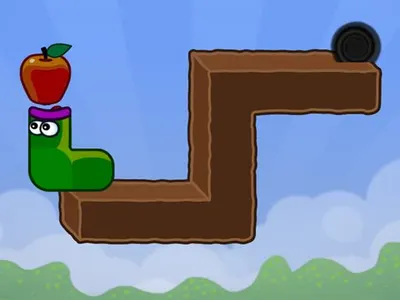
If you enjoy the feeling of planning a route in your head, try Unblock It 3D, where you rotate a cluster of arrowed blocks and slide them away one at a time. Apple Worm is another puzzle where the shape of your path matters as much as the destination, and the game lets you press R to restart a level when it goes wrong.
If you prefer something calmer, Water Sort Puzzle asks for the same kind of care about free space. You will find more in the puzzle category, and our article on the best free puzzle games is a good starting point.
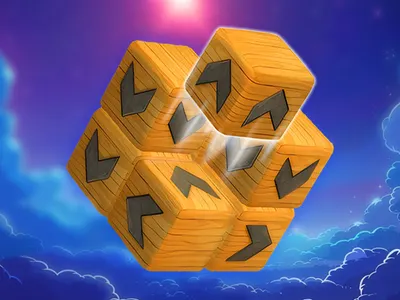 Unblock It 3D Spin a cube made of arrowed blocks and slide them away one by one until nothing is left. Play Unblock It 3D
Frequently asked questions
Can I jump in any direction?
A peg jumps over a neighboring peg into the empty hole directly beyond it. Check the game's instructions to see which directions the board allows.
Is it a failure if I end with two pegs?
Two pegs is close, but the aim is a single peg. If you finish with a few, look at your earliest moves, because the cause is usually there.
Is there a trick to solving it?
There is no single trick. Working from the outside in, keeping pegs together and checking what each jump leaves behind will get you there with practice.